Technical note
Designing trusted state for sports pools
Sports pool software is trust software. The product has to make picks, lock windows, scoring changes, standings, private pool rules, and validation failures understandable enough that people believe the result.
Related public proof: Poolhouse case study
Sports pool products can look simple from the outside. A group sets rules, people make picks, games happen, and standings update. The interface may only need a handful of screens.
The hard part is that everyone involved has to believe the product is telling the truth. A leaderboard does not help much if a pick appears to lock too early, a scoring correction arrives without context, or a private pool rule only becomes visible after it blocks someone.
In those moments, the product is not being judged by how polished it looks. It is being judged by whether the state feels understandable, fair, and durable. That makes trust the real product surface.
Validation Should Happen Before Persistence
Pick validation is not just form cleanup. In a sports pool, invalid picks create social and operational friction. A late pick, duplicate selection, format-incompatible choice, or missing tiebreaker can change how fair the pool feels.
The product should make the rules legible before it saves anything important.
- Explain what the user is allowed to pick.
- Disable impossible choices before they feel available.
- Separate missing information from invalid information.
- Show deadline and lock state near the action.
- Keep failure messages tied to pool rules rather than internal constraints.
The interface does not need to expose every implementation detail. It does need to keep available actions close to the actual pool state. If a user can tap something, they should have a reasonable expectation that the product can honor it.
Lock Windows Are Product State
A lock window may be stored as a timestamp, but users experience it as a product promise. Before the lock, a pick can be changed. At the lock, the rules shift. After the lock, the product has to explain why the choice is frozen.
Open, locks soon, locked, pending, corrected, and final are different states. They should look different, behave differently, and answer different user questions.
The uncomfortable cases matter most:
- A game starts while someone is viewing the pick screen.
- A user returns to an old browser tab or stale mobile state.
- A sport schedule changes after the pool deadline was shown.
- A private pool has rules that differ from another pool the same person joined.
- A scoring update changes after the standings have already moved.
In those cases, the product should prefer a truthful blocked state over an optimistic action that fails later. A clear locked moment is better than a button that appears available and then quietly refuses the pick.
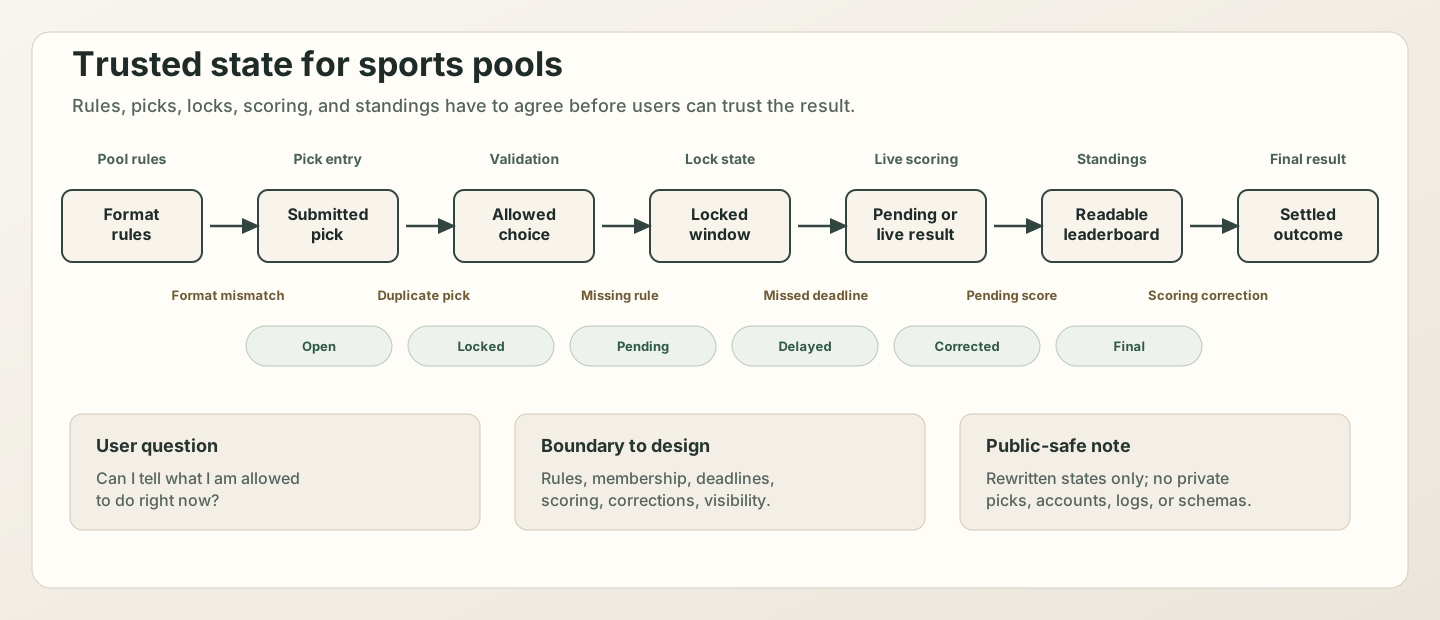
Follow One Pick Through The System
The easiest way to find trust problems is to follow one rewritten pick from entry to final standings.
Scroll horizontally to read all table columns.
| State | What the user sees | Product responsibility |
|---|---|---|
| Open | The pool accepts picks for the current window | Show eligible choices, deadline, format rules, and missing requirements |
| Locked | The pick can no longer be changed | Freeze the submitted choice and explain the lock boundary |
| Pending | The related game or scoring input has not resolved | Keep standings provisional and avoid implying the result is settled |
| Corrected | A prior value changed after the user saw an earlier state | Make the change visible enough that standings movement is understandable |
| Final | The result is settled enough for the pool | Treat standings and outcomes as durable until a deliberate correction occurs |
This table is not a database model. It is a product model. It gives the team a shared way to ask whether the interface, validation, background updates, and copy all agree about what the user is allowed to believe.
If the pick appears editable in one place and locked in another, the product has a trust problem. If standings move without showing that a game was pending or corrected, the product has a trust problem. If private pool rules only appear after a failed action, the product has a trust problem.
Automated Scoring Should Admit Uncertainty
Automated score synchronization creates a different kind of pressure. People want standings to feel current, but refreshed sports data moves through states that are not always final. Games can be delayed, corrected, overturned, or settled later than the UI suggests.
Useful scoring interfaces admit that uncertainty without making the whole product feel unstable.
Scroll horizontally to read all table columns.
| State | Product meaning | User expectation |
|---|---|---|
| Pending | The game or scoring input has not resolved | Standings may change |
| Current | The latest bounded refresh succeeded | Movement can still occur while inputs remain unsettled |
| Saved results | A transient refresh failed and a labeled last-good snapshot remains | Use the retained result without mistaking it for current data |
| Unavailable | No safe current or saved result can be shown | Provide retry context without inventing a standing |
| Final | The result is settled enough for standings | Treat the pool state as durable |
The point is not to explain the scoring provider. The point is to avoid presenting moving state as if it were already settled.
Private Pools Need Visible Boundaries
Private pools add another layer of trust because rules, membership, visibility, and deadlines belong to a specific group. A person should be able to tell which pool they are in, what format they are playing, which rules apply, whether their picks are visible, and what state their membership is in.
This is where small wording and layout choices matter. Pool identity, format, rule status, and pick status need to stay close to the actions they govern. A shared product shell can support survivor, wins, squares, 10-digit, spread, and match-play formats, but each format should keep its own rules and status language.
For Poolhouse, the public case study frames this as a state problem rather than a styling problem: multiple formats share one cross-platform surface, while validation, scoring, deadlines, private pool state, and leaderboard behavior stay specific to the format and group.
Good Evidence Avoids Private Data
A public product note should not need private screenshots or schema details to prove the thinking. The safer evidence is a decision model: what states exist, what users can do in each state, what can fail, and how the product keeps the next action understandable.
For sports pools, useful public evidence can be:
- A generalized state table.
- A diagram from rules to validation to private pool state to scoring.
- A rewritten pick-flow example with no real user data.
- A case-study link showing the public product boundary.
That keeps the proof inspectable without exposing the things a private pool product is supposed to protect.
The deeper principle is portable: when timing or group trust is attached to a workflow, state is not an implementation detail. State is the product's promise. The interface has to make that promise visible enough to believe.